

We are creeping up on the start of year 13 for this blog. I am just letting that sink in for a minute or two. I never in my wildest dreams thought I would still be writing “Ten Things” here in 2026. Mostly because I was worried I would run out of things to say – or ink. But here I am working my way through my notebook of potential topics, thinking, “This guy has way too much time on his hands” and “Why did I draw a picture of Ronald McDonald with a chainsaw?” I am sure the former is true, and the latter may finally give Mrs. Ten Things the ammunition she needs to have me committed to the Seward Sanitarium[1] so she can keep the vast blog royalties for herself and her growing collection of cats.[2] Or it may just be that it’s Halloween and there is nothing scarier than a ghoulish hamburger guzzling ex-rodeo clown with a chainsaw. Well, hold on a minute. There is one thing scarier, at least to someone who got to the general counsel chair via the litigation side. What’s that, you ask? Sure, I’ll tell you: class actions! Those two words should send shivers down the spine of any self-respecting in-house lawyer. Perhaps the only thing scarier would be hearing the general counsel say, “We are going to begin tracking our time starting on Monday.” Sorry, that last one was pretty dark even for Halloween. And, as usual, I am off on a tangent, so let’s bring it home.
As you can tell from the title of this post (and if you missed it, just look six inches above), we are going to dive deep into the guts of class actions and – more importantly – how you can best prepare in advance to deal with them should you find any rapping, rapping on your door in the middle of the night[3] …or day. That’s right, this edition of “Ten Things” is going to walk you through how to prepare for a class action lawsuit before it happens with the goal of reducing exposure, preserving defenses, and improving the ability of the company to respond. So, fill up the moat, drop the portcullis, man the walls, and let’s get going:
1. What’s a class action? Oh crap, I should have anticipated that. Umm… well, for those who don’t know, a class action lawsuit is litigation where one or more plaintiffs bring claims on behalf of a larger group of individuals who have all allegedly suffered the same harm from a company’s conduct, products, services, or business practices. Class actions pose big risks to companies because they can transform what might otherwise be small individual claims into large-scale litigation involving hundreds, thousands, or even millions of potential claimants. This means that even when the alleged damages to each individual are minimal, the combined financial exposure can be gigantic, especially when statutory damages, attorneys’ fees, punitive damages, or injunctive relief are available. Beyond the potential for significant judgments or costly settlements, class actions can create crippling discovery burdens, disrupt business operations, attract regulatory scrutiny, and expose companies to reputational harm and negative publicity. Most importantly, the certification of a class can dramatically increase litigation leverage and settlement pressure, even where the company has strong legal defenses. For in-house counsel, class action litigation represents not just a legal dispute, but a potentially enterprise-wide financial, operational, and reputational threat that can dramatically alter the financial future of the company. In other words, they are scary AF.
2. Identify where your class action risk lives. Now that I have your attention (sorta), let’s start digging in. The first thing to focus on is identifying where the risk of class action litigation lies with your company. The key is to look for company business practices that affect large groups of customers, employees, or other stakeholders in the same way. Most class action risks do not arise from isolated mistakes, but from systemic practices, automated processes, or recurring errors that can give rise to similar claims across a large group of people (who have access to lawyers). The question to ask is, “If this practice does not comply with the law or a regulation, how many people could be affected, could they assert substantially the same claim, and are they smart enough to hire a lawyer?” Here are the things I would focus on first:
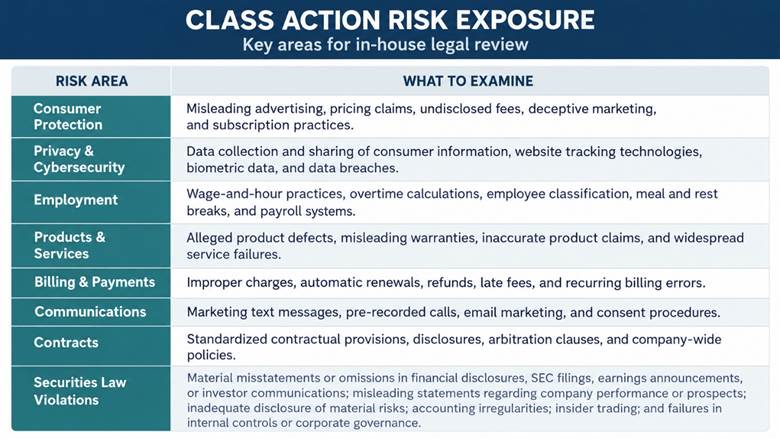
Consider using the above to start to create your own list of risk areas to dive into over the course of the next several months or as a department goal for 2027.[4]
3. Build an early-warning system. You may have been wondering, “How can I use data to proactively manage risk for the company?” Well, here’s your chance! You can often spot class-action risk through operational data. You just need to get your hands on some. Here are some potential sources:
- Track patterns in customer complaints, refunds, chargebacks, cancellations, and escalation requests. Look internally and externally, e.g., Better Business Bureau.
- Monitor employee complaints, hotline reports, demand letters, and administrative charges.
- Look for repeated allegations in social media, online reviews, and support tickets.
- Hire a service to monitor social media for plaintiff firm campaigns advertising for potential lead plaintiffs (yes, this is a thing).
- Track regulator inquiries and enforcement trends relevant to the company.
- Require business teams to escalate complaints that use litigation-oriented language such as “everyone,” “systemic,” “illegal practice,” or “class action.”
- Keep an eye on complaints against competitors.
- Ask trade associations for data.
- Look for government sources of complaints, e.g., the CFPB’s Consumer Complaint Database, the FTC’s Consumer Sentinel Network, the FCC’s Consumer Complaints Data Center (good for TCPA claims), or mine key states for consumer complaints to attorneys general (see, e.g., https://www.naag.org/our-work/center-for-consumer-protection/consumer-file-a-complaint/).
Another tool to use – once you gather your sources – is Generative AI. Imagine your company receives 10,000 customer complaints annually.[5] Individual complaints are typically handled by customer service representatives, and only a small percentage are escalated to the legal department. You can use AI to help you analyze all the complaints and look for patterns. Here’s a prompt designed to do just that:[6]
Prompt: Analyze the attached customer support complaints to identify recurring issues, patterns, or systemic business practices that could create potential class action litigation exposure. Group similar complaints by issue, identify trends or increases in frequency, and determine whether the same alleged problem may be affecting multiple customers. Highlight potential legal or regulatory concerns, estimate the number of affected customers where the data permits, and prioritize issues based on potential litigation risk. Provide a concise summary of the most significant findings, supporting complaint examples, and recommended areas for further investigation by in-house counsel. Distinguish verified facts from potential concerns and do not assume that complaints establish legal violations.
4. Review contracts and terms of use with class action litigation in mind. Here’s a tip: do not wait for litigation to evaluate your procedural defenses. The single best thing you can do to protect your company from class action litigation is to make sure your contractual protections are rock solid. But the time to do it is before you have a class action on your hands. Here’s how to conduct a class action defense audit of the company’s contracts, terms of use, and dispute-resolution procedures. Your goal is to determine whether the company has enforceable contractual protections in place and – equally important- whether it can actually invoke those protections when litigation arises. And, if not, what do you need to do to get those provisions in shape? Yet, another perfect task for Generative AI (at least for the initial review and recommendations for updates).

Remember that the right contract wording is only part of the battle; whether your beautiful language is worth anything depends on how the agreement is presented, accepted, updated, and documented. In particular, (a) preserve proof of consent, notice, and assent, (b) use clickwrap vs. browserwrap agreements, (c) don’t bury the provisions deep inside a 20-page set of terms of use – tell the user up front that the terms of use include arbitration, class-action waiver, jury waiver, limitation on damages, etc. The question to ask yourself here is, “If necessary, can we prove exactly what a plaintiff saw and agreed to [x] years ago?” For more, see How to Update Your Terms of Service Without Losing Legal Protection.
5. Establish your response team and response plan. The next step is to establish a “Class Action Response Team”[7] before litigation arises, with clearly defined responsibilities, decision-making authority, and escalation procedures. Your objective is to ensure that when a threatened or filed class action emerges, the company can respond quickly, preserve relevant evidence, assess its potential exposure, coordinate a legal defense, and manage operational and reputational risks. To do this right, you need to get five things in place:
- The response team comprised of Legal, Compliance, HR, IT/Information Security, Product/Operations, Finance, Risk Management/Insurance, Communications, and an executive sponsor (who is not part of the legal department).
- Clear decision-making authority via a written response plan identifying who has authority to make critical decisions. This avoids delays, conflicting instructions, and unauthorized communications. While many things can be decided at this level or even the C-Suite, some items may require board of directors’ approval, and those thresholds should be set out before there is a problem.
- A written class action response playbook that sets out several stages of the response, i.e., (a) initial activation (the legal team assesses the demand or complaint and activates the right team members), (b) the first 24-48 hours (identify outside counsel, evaluate defenses, establish the initial litigation strategy, and establish communications protocol), (c) the first week (determine the scope of the claim, identify the company practices at issue, hone the litigation strategy), and (d) the first 30 days (coordinate discovery planning including litigation hold, notify insurance carrier, develop reporting cadence for the C-Suite and the board of directors, and set the calendar for meetings of the response team).
- Get the “Big 4” in place, i.e., (a) preservation of documents, (b) the external/internal communications plan, (c) insurance review, and (d) preserving the attorney-client and work product privileges as to the internal investigation and communications (and ensuring that everyone understands how it all works).
- An annual tabletop exercise to walk through a hypothetical class action to see what parts of the response plan need refining. The goal is to identify missing procedures, unclear authority, and information-access problems. Once completed, assign an owner and deadline to correct each deficiency.
Long story short, an effective class action response begins long before a lawsuit is filed.
6. Conduct an insurance coverage audit. Partner with Finance, Risk Management (or whoever is responsible for insurance at the company), and the company’s insurance broker to review existing policies and identify which ones might respond to different class action claims. Here is the list: Directors & Officers, Errors & Omissions, Cyber-Risk, Employment Practices Liability, Commercial General Liability, Product Liability, and any other specialized coverage like media or technology liability. Remember, coverage depends on the actual policy language, applicable exclusions, endorsements, the allegations, and governing law. So, it pays to know in advance what you have and, more importantly, what you do not have. Read your policies![8] The key provisions to focus on include notice requirements, the definition of a claim, claims made vs. occurrence coverage, defense costs, counsel selection (and rate payable),[9] settlement consent, and deductibles/retention limits. Pay particular attention to defense costs. Some policies contain “defense-within-limits” provisions, meaning legal fees and other defense expenses reduce the amount of insurance remaining to pay a settlement or judgment.
Next, focus on establishing a process to notify claims to the insurer. Your broker should be a great resource here. Do not assume that notice to an insurance broker automatically satisfies the policy’s notice requirements. You should verify the specified recipients, methods, and deadlines under each policy. Claims-made-and-reported policies deserve particular attention because reporting requirements can be critical to preserving coverage. Additionally, understand the scope of your ability to retain counsel or settle claims. For example, can the company retain its preferred outside litigation counsel? Must the insurer approve hourly rates or litigation budgets? Does the insurer have the right to participate in settlement negotiations? These, and other questions, should be resolved as early as practicable. Lastly, review your policies at least once per year and certainly prior to renewal. Know what coverage you have and what conditions must be satisfied to preserve it – before there is something to notice to your insurer.
7. Pre-select class action counsel. One effective step in-house counsel can take to prepare for class action litigation is to identify and establish relationships with outside defense counsel before a lawsuit is filed. Given that the first days of a significant class action can involve urgent preservation obligations, litigation deadlines, public relations concerns, and important strategic decisions. Having experienced class action counsel ready to respond can give you peace of mind and a substantial advantage vs. starting from scratch when the shit hits the fan. The first days of a class action should be spent developing the defense – not interviewing law firms, negotiating hourly rates, or conducting an RFP. And rather than just one firm, consider creating a panel of preferred class action counsel. Having several firms on speed dial is a smart way to ensure you make the best pick for your particular matter. Here are some key questions to ask when putting your panel together (ideally through an RFP process):
- Does the firm have substantial experience defending class certification, pursuing early dismissal, and managing complex class litigation?
- Does the firm understand your company’s operations, regulatory environment, and recurring litigation risks?
- Can the firm handle consumer protection, privacy, employment, securities, or other relevant claims?
- Can the firm immediately address emergency injunctions, preservation issues, and expedited discovery?
- Does the firm have experience handling multidistrict litigation, nationwide class actions, and parallel regulatory proceedings?
- Will the firm negotiate preferred rates, alternative fee arrangements, budgets, and reporting requirements before litigation arises?
Additionally, make sure that the firms on your panel meet the requirements of your insurance policies. And be sure to extract[10] some additional value from the firms on your panel in terms of an annual meeting to discuss emerging class action trends, potential vulnerabilities in company practices, review of your arbitration, class action waivers, tabletop exercises, best practices to preserve privilege, and review of discovery protocols in the event you are hit with a class action case.
8. Fix issues before they become problems. An important responsibility of in-house counsel is to ensure that known systemic legal risks are identified, evaluated, and addressed before they develop into class action litigation. Companies sometimes continue potentially problematic practices because they have been in place for years and changing is “hard” or because changing them raises concerns about admitting prior wrongdoing. However, allowing a known problem to continue can increase the number of affected individuals, the potential damages, and future litigation exposure. So, it’s better to fix it now vs. hoping you won’t get caught – because the latter strategy doesn’t work any better now than it did when you were 15 and sneaking beers out of granddad’s garage refrigerator (or maybe that was just me?). Anyway, forget about the beers and focus on these steps:
- Establish a remediation process – when you identify a real systemic risk, coordinate with Compliance, Operations, Finance, and other relevant departments to determine whether corrective action is warranted. To do this, (a) consider the scope of the problem in terms of number of people affected and potential damages, (b) determine if the company should discontinue, modify, or replace the practice in question, (c) identify the appropriate remedy, e.g., refunds, credits, etc., (d) consider what policies, training, and procedures are needed to fix it, (e) document the legal and business rationale for the changes (but keep privileged legal advice separated from the documentation), and (f) follow up to make sure the fixes actually fixed the problem.
- Address concerns about subsequent remedial measures – a common concern is that plaintiffs will argue that changing a business practice demonstrates that the company’s previous conduct was unlawful. In federal litigation, Federal Rule of Evidence 407 and state equivalents generally limit the use of subsequent remedial measures to establish negligence, culpable conduct, product defects, or the need for warnings. However, the rule contains exceptions, including certain uses to establish ownership, control, feasibility, or impeachment. This is where your panel counsel can start to earn their keep, i.e., bring them to evaluate proposed remediation rather than assume that corrective action will necessarily be admissible (or automatically protected) from later use in litigation.
- Monitor unresolved risks – maintain a process for tracking identified systemic risks, assigning responsibility, establishing remediation deadlines, and escalating significant unresolved issues to executive leadership. The key is to prevent an identified problem from becoming a continuing business practice.
The fact that a business practice has always been followed does not justify continuing it. Fear that corrective action might be portrayed as an admission of wrongdoing should not prevent a company from fixing the problem.[11]
9. Protect the attorney-client privilege. Proactive class action risk assessments can help you identify and correct potential legal problems before litigation arises. But if not properly structured, these reviews may be a time bomb from ACME products, generating sensitive documents, communications, and analyses that plaintiffs could later obtain through discovery. Consequently, in-house lawyers must establish procedures designed to protect legitimate attorney-client privilege and work-product protections while ensuring that relevant facts are preserved and compliance issues are appropriately addressed. Sounds hard, right? It is. But it is doable. Here are the steps to ensure the best possible chance that legitimate privileged communications are treated that way by the court:
- Clearly define the legal purpose of the investigation.
- Ensure that the legal department (or outside counsel) is directing the investigation for the purpose of providing legal advice
- Limit distribution of the communications to those with a need-to-know, separate the legal work from ordinary compliance monitoring or operational audits, train the business when and how to mark documents as “Privileged.”
- Be very careful when engaging any third-party consultant or other advisors (and structure the agreements with such parties carefully).
I want to emphasize the importance of training the business on how the privilege and work-product doctrine work. Create a short training session for executives and front-line employees involved in the internal investigation.[12] But be sure to emphasize that legal advice must be distinguished from routine business discussions, sensitive legal analyses should not be distributed unnecessarily, and third-party involvement should be reviewed with counsel. Over-labeling of documents as “privileged” can cause the court to believe that the company is using the attorney-client privilege to try to hide otherwise raw business communications. That is not a fight you want to have. The important thing for everyone to remember is that simply labeling a document as “privileged” does not make it so. And copying a lawyer on an email does not magically turn that email into a privileged document. Failing to take the right precautions can be the same as handing opposing counsel or regulators a roadmap labeled “How to Kick Our Ass in Litigation.” Don’t draw that map!
10. A readiness checklist. You all know I am a sucker for a checklist. Here is one I created to help you determine if you are ready if a class action lawsuit hits the door next week:[13]

*****
I realize I have laid out a lot here for you to consider. You do not need to do all of it tomorrow (or even on Monday). Pick the pieces that you think will have the biggest impact and start there. Then, over time, begin to flesh out the rest. It can be a legal department goal for 2027. The lesson here is that every step you take to shore up the company’s defenses (and readiness) to defend class actions, the better off you and the company will be. The added benefit is that a proactive legal department is a valuable legal department. So, make sure people in the business know what you are doing and why it’s important. Hopefully, you’ll never need to use any of this. But if you do, you’ll be very glad you spent the time getting ready.
Sterling Miller
October 31, 2026
I am working on book number eight. But if you need a book now, I have seven you can choose from (especially if you need a gift for a lucky member of an in-house legal department)!
- Ten Things You Need to Know as In-House Counsel – Practical Advice and Successful Strategies
- Ten (More) Things You Need to Know as In-House Counsel – Practical Advice and Successful Strategies Volume 2.
- Showing the Value of the Legal Department: More Than Just a Cost Center
- The Productive In-House Lawyer: Tips, Hacks, and the Art of Getting Things Done
- More Slow-Cooker Savant
- The Evolution of Professional Football
- The Slow-Cooker Savant.
I am also available for speaking engagements, webinars/CLEs, coaching, training, pet sitting, bartending, rug cleaning, and consulting. Connect with me on Twitter @10ThingsLegal and on LinkedIn where I post articles and stories of interest to in-house counsel frequently. “Ten Things” is not legal advice nor legal opinion and represents my views only. It is intended to provide practical tips and references to the busy in-house practitioner and other readers. If you have questions or comments, or ideas for a post, please contact me at sterling.miller@outlook.com or if you would like a CLE for your in-house legal team on this or any topic in the blog, contact me at smiller@hilgerslaw.com.
[1] My undying admiration if you guess the reference.
[2] Reality Alert: there are no royalties! Joke’s on her… or is it me?
[3] Yep, another chance to guess the reference and earn undying admiration points, which are kind of like Green Stamps – not worth much in the real world.
[4] This isn’t something you will do in a week. It is a long-term process to continually look to identify potential class action risks and nip them in the bud before they can actually become a problem.
[5] If it does, I feel sorry for you. When I was general counsel at Sabre Corporation, we may have had 10,000 complaints a year, but 9,999 came from one customer whom I shall not name.
[6] You knew I was going to mention AI, right?
[7] Kind of like the Super Friends but way more boring.
[8] I know it makes your head hurt to read them but it is a necessary step.
[9] This is an area where in-house lawyers are often surprised, i.e., they cannot pick their own counsel, and the hourly rate provided for under the policy is ridiculously low. This is why reading the policies is so important.
[10] By “extract,” I mean on their dime. All you have to do is ask.
[11] Even my granddad eventually wised up and put a padlock on the beer fridge. Which is how I learned to pick locks. I was, indeed, a determined young man.
[12] Yet another opportunity to extract value from panel counsel (or use Generative AI to create it).
[13] You may have noticed that I have upped my graphics game. I am using Generative AI to create graphics. It works great. Also, I will never refer to Artificial Intelligence as Super Intelligence. Just like I will always call it Twitter. And if I see a “Family Circus” cartoon, I will put it to the torch like a horde of villagers surrounding Baron Frankenstein’s castle. If all that makes me your enemy, sorry.











Leave a Reply